How Rapeseed Oil Is Manufactured: From Seeds to Finished Product
Have you ever wondered how tiny rapeseed seeds are transformed into the edible oil used in kitchens and food businesses? The journey involves much more than pressing seeds and collecting oil. It begins with selecting suitable raw materials and continues through cleaning, extraction, filtration, quality checks and packaging.
For consumers, understanding this process helps explain why oils can differ in colour, aroma and consistency. For wholesalers, distributors, food businesses and international buyers, it provides a better understanding of the manufacturing practices that influence product quality and supply reliability.
Rapeseed oil manufacturing involves preparing suitable seeds, extracting their oil, separating impurities, checking product quality and packaging the finished oil under appropriate conditions. The exact process depends on the seed variety, extraction method, intended product and applicable food standards.
For businesses sourcing rapeseed oil from India, understanding these stages also makes it easier to evaluate a manufacturer and ask the right questions before placing an order.
What Is Rapeseed Oil?
Rapeseed oil is a vegetable oil obtained from seeds belonging to the Brassica group of oilseed crops. In India, rapeseed-mustard includes several crops and varieties, such as toria, yellow sarson and Indian mustard. These crops are closely related, but their seeds and resulting oils are not necessarily identical.
Indian food standards use the term “rapeseed oil (toria oil) or mustard oil (sarson ka tel)” for a defined category of edible oil. The standards also specify product parameters that the oil must meet. This is why manufacturers and buyers should consider the actual seed, product specification and applicable classification instead of assuming that every rapeseed oil and mustard oil is interchangeable.
Rapeseed oil is used in different food applications depending on its composition and processing method. In India, related oilseed products are also commercially associated with yellow mustard oil and traditional mustard oil. If you want to understand how these products differ, read our guide on Rapeseed Oil vs Mustard Oil: Understanding the Difference.
How Is Rapeseed Oil Manufactured?
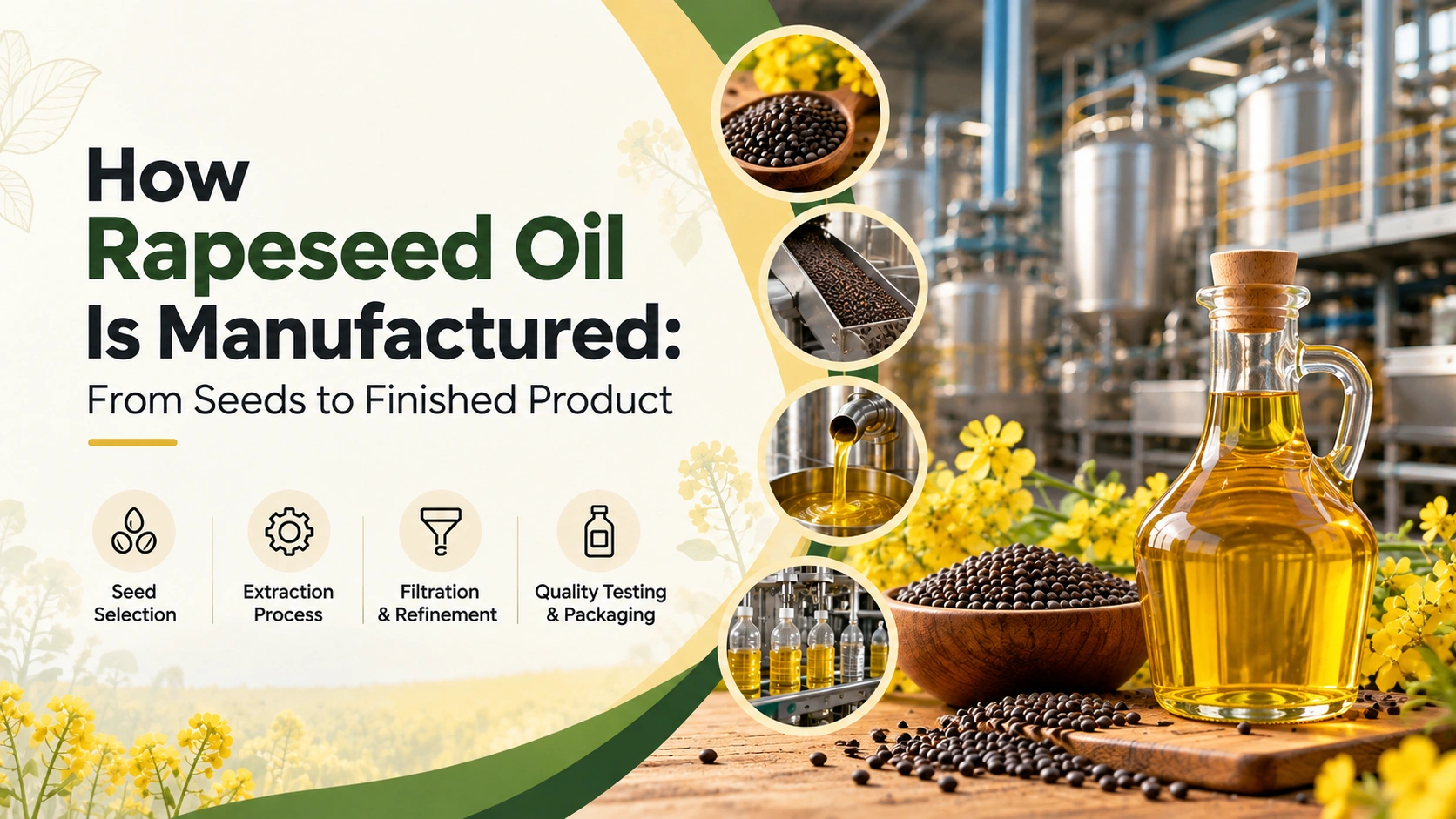
The manufacturing process can be understood through six main stages: seed selection, cleaning, preparation, oil extraction, filtration and quality control before packaging. Although the precise equipment and operating conditions vary between facilities, every stage contributes to producing a consistent finished product.
1. Selecting and Inspecting Rapeseed
The quality of the finished oil starts with the raw material. Manufacturers need suitable rapeseed that meets their intended product specifications. Seed variety, maturity, moisture, storage conditions and the presence of foreign material can influence how the seeds perform during processing.
Before production, the incoming seeds should be inspected for visible impurities, damaged material and signs of unsuitable storage. Depending on the manufacturer’s quality system, additional checks may be required to evaluate moisture, contamination and other relevant characteristics.
For example, seeds stored in damp conditions may develop quality problems that affect the resulting oil. Careful inspection helps manufacturers identify unsuitable raw materials before they enter the production line.
For B2B buyers, this stage is worth discussing with a potential supplier. Ask how the manufacturer selects raw materials, manages incoming inspections and maintains traceability between raw-material batches and finished products.
2. Cleaning the Seeds
After selection, the seeds pass through cleaning equipment to remove unwanted material. Depending on the equipment used, this may include screens, aspiration systems, magnets and other separation methods.
The cleaning stage can remove dust, stones, plant debris, metal fragments and other foreign materials. This protects downstream equipment and helps prepare the seeds for consistent processing.
Cleaning is not simply a cosmetic step. Foreign materials can interfere with machinery, increase wear and create avoidable production problems. A well-managed cleaning process also supports the manufacturer’s broader food-safety and quality-control system.
The precise cleaning arrangement depends on the incoming seed condition and the plant’s equipment. Manufacturers should establish appropriate checks to confirm that the cleaned seeds meet their production requirements.
3. Preparing the Seeds for Extraction
Once cleaned, the seeds are prepared for oil extraction. This stage varies according to the extraction technology and the product being manufactured.
Some processes use mechanical pressing, while others may include seed conditioning or other preparation steps. Depending on the equipment, preparation can influence how efficiently the oil is released and how the material behaves during extraction.
Temperature management is particularly relevant when a product is intended to meet a cold-pressed or Kachi Ghani specification. Manufacturers must control the process in a way that supports the applicable product requirements rather than relying only on the machinery’s name or marketing description.
This is also where buyers should distinguish between the type of oilseed and the method used to process it. Rapeseed oil describes an oil category, whereas terms such as cold pressed and Kachi Ghani relate to processing and associated product requirements.
4. Extracting the Oil
Oil extraction is the central stage of rapeseed oil manufacturing. The method used depends on the product, equipment, scale of production and intended market.
Mechanical pressing: In mechanical extraction, prepared seeds are pressed using suitable machinery. Pressure helps release the oil from the seed material, producing crude or unfiltered oil that may contain fine seed particles and other suspended material.
Mechanical pressing is commonly associated with cold-pressed and traditionally processed oils, although the actual extraction conditions determine whether a finished product qualifies for a particular processing claim.
Solvent extraction: Some industrial oil-processing operations use an approved solvent-based method to recover oil from prepared oilseed material. This involves specialised equipment and controls for solvent handling, recovery and residual-solvent management.
The two methods should not be treated as identical. They have different processing requirements and may result in products that need different downstream treatment. Under India’s food standards, oils obtained through solvent extraction must meet the applicable refining and other regulatory requirements before being supplied for human consumption.
For buyers, the important questions are straightforward: Which extraction method does the supplier use? What product specification is being offered? Does the finished oil comply with the requirements applicable to that product?
5. Filtration and Oil Clarification
After extraction, the oil may contain suspended particles, seed residues and other impurities. Filtration helps separate these materials from the oil and improves its clarity.
The filtration system depends on the manufacturing process and the intended finished product. Manufacturers may use suitable filter presses or other filtration equipment to remove suspended material and achieve the required product characteristics.
Double filtration refers to an additional filtration stage or a process involving two filtration steps. However, the term alone does not establish that an oil is superior in every respect. The actual filtration process, final specifications and quality results remain important.
It is also essential to distinguish filtration from refining. Filtration removes suspended material, while refining involves additional processing steps intended to modify or remove particular components. A filtered oil should not automatically be described as refined, and a double-filtered product should not automatically be presented as having a particular health advantage.
For a related explanation, read Kachi Ghani Mustard Oil: Meaning, Processing and Key Features.
6. Quality Testing Before Packaging
Before the oil is released for packaging or dispatch, the manufacturer should verify that it meets the applicable product specification. Quality control may involve checks on appearance, odour, moisture, impurities and relevant chemical parameters.
For rapeseed or mustard oil, the applicable FSSAI standard includes parameters such as refractive index, saponification value, iodine value and acid value. The relevant standard also includes specific safety and product-identity requirements. The precise testing plan should follow the current regulations and the finished product’s specification.
Quality testing helps manufacturers identify deviations before products reach distributors, retailers or consumers. It also provides useful information for batch records, customer documentation and supplier evaluations.
For B2B purchasing, buyers should ask which tests are conducted, how batches are identified, whether relevant test reports are available and how non-conforming products are handled. These questions are more useful than relying only on broad claims such as “premium quality” or “pure oil.”
You can refer to the official FSSAI product standards for the regulatory framework governing edible oils in India.
7. Packaging and Storage
Once the finished oil meets the applicable requirements, it can be packed into suitable containers. Packaging options depend on the target customer and distribution model.
Retail customers may require smaller bottles, while wholesalers, distributors and institutional buyers may prefer larger packs. Packaging materials must be suitable for food contact and should protect the oil during handling, transportation and storage.
Manufacturers also need to consider filling accuracy, container integrity, sealing, labelling, batch identification and traceability. Proper storage and stock rotation help reduce avoidable deterioration during distribution.
For international shipments, packaging and documentation may need to satisfy additional destination-market requirements. Importers should confirm these requirements before an order is finalised rather than assuming that packaging accepted in India will automatically meet every overseas market’s rules.
What Factors Affect the Quality of Rapeseed Oil?
Oil quality is influenced by more than the extraction machine. Raw-material selection, seed storage, processing conditions, filtration, packaging and the manufacturer’s quality controls all contribute to the final product.
| Manufacturing factor | Why it matters |
|---|---|
| Seed quality | Influences raw-material suitability and the characteristics of the resulting oil. |
| Moisture and storage | Poor storage conditions can contribute to deterioration before processing. |
| Extraction method | Determines the processing route and the controls required for the intended product. |
| Filtration | Helps control suspended particles and product clarity. |
| Quality testing | Checks whether the finished oil meets the applicable specification. |
| Packaging | Protects the product during storage, handling and distribution. |
| Traceability | Helps identify batches and investigate quality issues when necessary. |
For manufacturers and bulk buyers, consistency across batches is particularly important. A supplier should be able to explain its specifications and quality-control procedures rather than relying solely on product descriptions.
Cold-Pressed Rapeseed Oil vs Refined Rapeseed Oil
The difference between cold-pressed and refined oil is primarily related to processing. Cold-pressed oil is obtained through mechanical extraction under conditions intended to meet the relevant cold-pressed requirements. Refined oil undergoes additional processing designed to achieve the characteristics specified for the refined product.
These products should be evaluated according to their actual specifications and intended applications. Cold pressed does not automatically mean that every quality parameter is better, just as refined does not automatically mean that an oil is unsuitable.
In India, the term “Kachi Ghani” or “Cold Pressed” may be used for rapeseed or mustard oil when the applicable FSSAI conditions are met, including the specified natural allyl isothiocyanate requirement. Manufacturers should verify the current regulations before making these claims on packaging or websites.
If you are comparing products for a business, check the extraction method, product specification, intended use and relevant quality documentation. Read our related guide on Premium Yellow Mustard Oil to explore the product category further.
How to Choose a Reliable Rapeseed Oil Manufacturer in India
Finding a supplier is only the first step. A reliable manufacturing partner should be able to explain its products, document its quality procedures and respond clearly to commercial requirements.
Start by checking the manufacturer’s business details and actual manufacturing arrangements. Confirm whether the company manufactures the product itself, works with a third-party manufacturer or operates through a combination of sourcing and manufacturing arrangements.
Next, ask for the product specification and relevant quality documentation. The documents should match the exact oil being supplied rather than a different product in the same category. If the order is intended for export, check the destination country’s requirements and agree on packaging, labelling, shipping terms and documentation before production or dispatch.
Buyers should also compare order quantities, available pack sizes, lead times, payment terms and the supplier’s ability to fulfil repeat orders. These details help determine whether a manufacturer is suitable for a long-term commercial relationship.
For businesses sourcing from Uttar Pradesh, Goyal Agro lists its manufacturing facility at Barabanki and its corporate office in Lucknow. Buyers can review the company’s product information and contact its team to discuss specific supply requirements.
Explore Goyal Agro’s website to learn more about the company and its product range.
Rapeseed Oil Manufacturing at Goyal Agro
Goyal Agro serves the Indian edible-oil market through product ranges that include Magh Premium Yellow Mustard Oil / Rapeseed Oil and Neelima Kachi Ghani Mustard Oil. The Magh range is presented as cold pressed and double filtered, with 1-litre, 5-litre and 15-litre formats. Neelima is offered in multiple formats, including 200 ml, 500 ml, 1 litre, 5 litres and 15 litres, according to the company’s product information.
These ranges address different product preferences and pack-size requirements. For retailers and distributors, the available formats can be relevant when planning product assortments. For bulk and international buyers, the more important next step is to confirm the exact product specification, available quantities, packaging suitability and destination requirements directly with the company.
Goyal Agro’s manufacturing facility is located at D-329, Agro Park, Phase-1, Industrial Area, Kursi Road, Barabanki, Uttar Pradesh, while its corporate office is in Lucknow. This distinction is useful for buyers searching for an edible-oil manufacturer serving Lucknow and the wider Uttar Pradesh market.
To discuss commercial requirements, use the company’s website to reach the relevant team. For certification information, refer to the Goyal Agro certifications page and verify the current validity and scope of any certificate relevant to your order.
Frequently Asked Questions
Learn how rapeseed oil is manufactured, how quality is checked, and what buyers should know before choosing a supplier.
1. How is rapeseed oil manufactured?
Rapeseed oil manufacturing generally involves selecting and cleaning suitable seeds, preparing them for extraction, recovering the oil, removing suspended impurities, testing the finished product and packaging it. The exact process depends on the extraction method, seed variety and intended product specification.
2. What are the main steps in rapeseed oil production?
The main stages include raw-material inspection, seed cleaning, preparation, oil extraction, filtration, quality testing and packaging. Some manufacturing processes also include refining or other treatments, depending on the oil and its intended use.
3. Is rapeseed oil the same as mustard oil?
Not in every commercial context. Rapeseed and mustard belong to a closely related group of Brassica oilseed crops. Indian food standards use the term rapeseed oil (toria oil) or mustard oil (sarson ka tel) for a defined category. The seed, product specification and processing method determine the characteristics of the finished oil.
4. What is the difference between cold-pressed and refined rapeseed oil?
Cold-pressed oil is obtained through mechanical extraction under the applicable processing conditions. Refined oil undergoes additional processing to achieve specified characteristics. Buyers should compare the product specifications, extraction method and intended application rather than assuming one type is always better than the other.
5. How is rapeseed oil quality tested?
Quality testing depends on the product specification and applicable food standards. Relevant checks may include appearance, odour, moisture, impurities, acid value, iodine value, refractive index and other required parameters. Manufacturers should maintain appropriate records and verify that the finished oil meets applicable requirements.
6. What factors affect the quality of rapeseed oil?
Seed variety, raw-material quality, moisture, storage conditions, extraction method, filtration, handling and packaging can all affect the finished oil. Proper quality controls throughout production help manufacturers identify problems and maintain consistency between batches.
7. How do I choose a reliable rapeseed oil manufacturer in India?
Check the manufacturer’s business and production details, product specifications, relevant licences and certificates, quality-testing procedures, packaging options and supply capabilities. For bulk orders, confirm minimum order quantities, delivery schedules, batch traceability and commercial terms before placing an order.
8. What should bulk buyers check before purchasing rapeseed oil?
Bulk buyers should confirm the exact oil specification, extraction method, packaging format, available quantity, quality documentation, batch information, delivery terms and payment conditions. International buyers should also verify destination-market requirements and required import documentation before finalising an order.
9. Does Goyal Agro offer rapeseed oil and mustard oil products?
Goyal Agro lists Magh Premium Yellow Mustard Oil / Rapeseed Oil and Neelima Kachi Ghani Mustard Oil in its product portfolio. Buyers can contact Goyal Agro to confirm current product specifications, availability, packaging options and commercial supply requirements.
10. Where is Goyal Agro’s manufacturing facility located?
Goyal Agro lists its manufacturing facility at D-329, Agro Park, Phase-1, Industrial Area, Kursi Road, Barabanki, Uttar Pradesh, and its corporate office in Lucknow. Buyers should contact the company directly for current manufacturing, product and supply information.
Looking for a Rapeseed Oil Supplier in India?
Contact Goyal Agro to discuss product specifications, packaging and bulk supply requirements.
Explore Goyal Agro