Mustard Oil Exporter in India: A Sourcing Guide for Global Buyers
Buying mustard oil for an international market involves more than comparing prices. Importers need a reliable supplier, consistent product specifications, suitable packaging, accurate documentation and a clear understanding of destination-country requirements. A small gap in any of these areas can delay a shipment or create problems after the product reaches its destination.
India offers international buyers access to an established rapeseed-mustard oil industry and manufacturers serving different commercial requirements. However, choosing the right mustard oil exporter in India requires careful evaluation of the product, supplier and export process.
This guide explains how global buyers can source mustard oil from India, what they should verify before placing an order, and how to evaluate a manufacturer for long-term business.
Table of Contents
Why Source Mustard Oil from India?
India has a well-established agricultural and processing sector for rapeseed-mustard crops. The wider crop group includes varieties such as Indian mustard, toria and yellow sarson, which differ in their characteristics and intended applications. This diversity gives buyers several product specifications to evaluate when sourcing edible oil.
For international businesses, the decision should not be based on country of origin alone. The right supplier must understand the buyer’s product requirements, packaging preferences, documentation needs and target market. A supplier who can communicate these requirements clearly is better positioned to support a dependable business relationship.
Indian suppliers may serve food distributors, importers, wholesalers, ethnic grocery retailers and other commercial buyers. Some buyers need finished retail packs, while others require larger packaging formats for distribution or further commercial use. The appropriate option depends on the supplier’s actual capabilities and the destination market’s regulations.
Also read: Mustard Oil Manufacturer in Lucknow: What Should a Buyer Really Look For?
What Should Global Buyers Know About Mustard Oil?
Mustard oil is an edible vegetable oil associated with seeds from the Brassica group. In India, terms such as mustard oil, sarson oil, toria oil and rapeseed oil appear in agricultural, commercial and regulatory contexts.
These terms should not automatically be treated as interchangeable for every product. Seed variety, fatty-acid profile, extraction method and product specifications can affect the oil’s characteristics. Buyers should therefore confirm the exact product being offered rather than relying solely on a general product name.
Before requesting a quotation, decide whether your business needs conventional mustard oil, yellow mustard oil, Kachi Ghani mustard oil, cold-pressed oil or another specific product. If you are sourcing for a regulated overseas market, make sure the product’s composition, intended use and labelling meet the applicable requirements.
Types of Mustard Oil Products Buyers Can Source
Different buyers have different expectations. A retail distributor may prioritise pack sizes and shelf presentation, whereas a bulk buyer may focus on specifications, shipment quantities and supply consistency.
| Product Type | What Buyers Should Evaluate |
|---|---|
| Yellow Mustard Oil | Seed identity, product specifications, flavour profile and intended market. |
| Kachi Ghani Mustard Oil | Extraction process and compliance with applicable labelling requirements. |
| Cold-Pressed Mustard Oil | Actual processing method, product characteristics and supporting documentation. |
| Double-Filtered Mustard Oil | Filtration process, clarity expectations and quality specifications. |
| Rapeseed Oil | Exact seed or oil category, fatty-acid profile and relevant product standard. |
The product name is only the starting point. A professional supplier should be able to clarify which specification applies to the oil, what packaging is available and which documents can be provided for the intended shipment.
Also read: Rapeseed Oil vs Mustard Oil: Understanding the Difference
How to Choose a Reliable Mustard Oil Exporter in India
A supplier may offer an attractive quotation, but the lowest price does not necessarily represent the best commercial decision. Importers need to evaluate whether the supplier can meet their requirements consistently and communicate clearly throughout the order cycle.
1. Verify the Supplier’s Business and Manufacturing Details
Start by checking the supplier’s registered business information, operating locations and role in the supply chain. Determine whether the company manufactures the product itself, sources it from another manufacturer or operates under a merchant-exporter model.
Neither model is automatically unsuitable. What matters is transparency, traceability and the ability to fulfil the agreed order. If manufacturing capability is important to your business, ask for relevant facility details and supporting documentation.
2. Request a Detailed Product Specification
Avoid making a purchasing decision based only on a product brochure or a general description such as “premium mustard oil.” Ask for a specification sheet that identifies the product and its measurable quality parameters.
Depending on the product and destination market, these may include fatty-acid composition, relevant chemical and physical parameters, moisture and volatile matter, insoluble impurities, and other applicable safety or quality tests. The required parameters should follow the relevant product standard and the buyer’s intended use.
A clear specification helps both parties agree on what will be supplied and how conformity will be assessed.
3. Review Quality Control and Batch Documentation
Consistency matters when you are importing oil for regular distribution. Ask the supplier how it handles incoming raw materials, production batches, filtration, storage and finished-product checks.
Where applicable, request a certificate of analysis or batch test report. Confirm which tests were performed, which limits apply and whether the document relates to the actual product or batch being supplied.
Quality certificates and management-system certifications can provide useful supporting evidence, but they should not replace product-specific testing or verification of applicable food-safety requirements.
4. Confirm Export and Destination-Market Compliance
An exporter must understand the documentation and compliance requirements relevant to the product and destination. Requirements may differ by country, product classification, packaging format and intended use.
Before confirming an order, identify the applicable export policy, customs classification, food-safety requirements, labelling rules and import permissions. Where necessary, work with the destination country’s importer, customs broker or regulatory adviser to confirm the requirements in writing.
This step is especially important for edible oils because product classification and destination-specific rules can affect whether a shipment can be exported or imported as planned.
5. Evaluate Supply Capacity and Communication
Ask whether the supplier can support your expected order quantity, preferred pack sizes, delivery schedule and potential repeat orders. You should also establish who will coordinate production updates, documentation, dispatch and shipment-related questions.
For a long-term sourcing relationship, clear communication is just as important as the initial quotation. Agree on the product specification, payment terms, inspection arrangements and process for resolving any quality discrepancy before placing the order.
Mustard Oil Export Process: From Enquiry to Shipment
Understanding the export process helps buyers prepare the right information and avoid unnecessary delays. Although the exact procedure varies by shipment and destination, a typical sourcing journey follows these stages.
Step 1: Share Your Requirements
Tell the supplier your destination country, required oil type, intended use, packaging preference and estimated order quantity. If you have an existing specification, share it before requesting a quotation.
Step 2: Review the Product and Quotation
Evaluate the proposed specification, available pack sizes, order quantity, pricing basis, lead time and delivery terms. Make sure both parties understand what the quoted price includes and excludes.
Step 3: Verify Samples and Specifications
Where appropriate, arrange a product sample and review the available technical documentation. Agree on the acceptance criteria before approving the commercial order.
Step 4: Confirm Compliance and Documentation
Check the applicable export and import requirements. Confirm which documents the exporter can provide and which responsibilities belong to the importer, freight forwarder or customs broker.
Step 5: Approve Packaging and Shipment Arrangements
Confirm packaging suitability, labelling, quantity, shipment schedule and delivery terms. Packaging must protect the product during transportation and meet the destination market’s applicable requirements.
Step 6: Complete Dispatch and Document Handover
Coordinate shipment, customs clearance and the handover of agreed documents. The buyer and exporter should keep consistent records of the product, quantity, batch details and shipment.
A documented process helps reduce misunderstandings and makes repeat orders easier to manage.
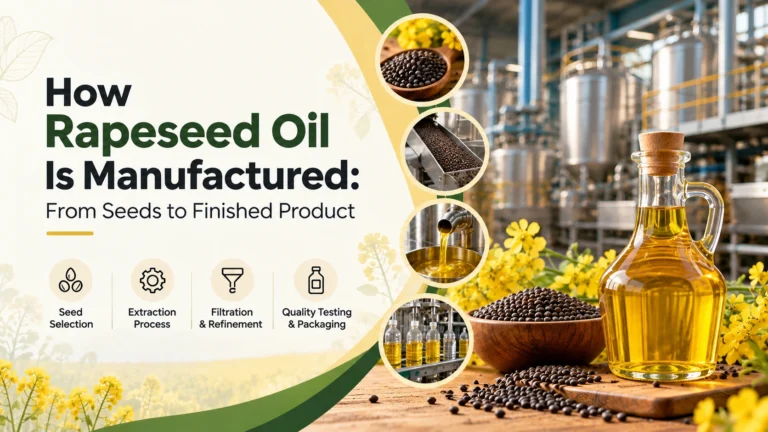
Also read: How Rapeseed Oil Is Manufactured: From Seeds to Finished Product
What Documents Should Buyers Discuss with an Indian Mustard Oil Exporter?
The exact document set depends on the product, transaction, export policy and destination country. Buyers should agree on the required documents before production or dispatch rather than assuming that every shipment follows the same checklist.
| Document or Record | Why It Matters |
|---|---|
| Commercial Invoice | Records the transaction value and commercial details. |
| Packing List | Identifies package count, contents and shipment information. |
| Shipping Document | Records transport details, such as a bill of lading for applicable sea shipments. |
| Certificate of Analysis | Provides batch or product test results when available and appropriate. |
| Certificate of Origin | Establishes origin when required by the transaction or destination. |
| Food-Safety or Health Documentation | Supports applicable regulatory requirements. |
| Export and Customs Declarations | Supports the required export clearance process. |
| Product and Label Specifications | Helps the importer verify product identity and market suitability. |
Additional documents may be required depending on the destination, shipping method, product classification or buyer’s contract. For this reason, the importer should confirm the final list with the exporter and the relevant customs or regulatory professionals.
Packaging Options for International Mustard Oil Buyers
Packaging affects transport, storage, handling and the buyer’s distribution model. The right format depends on order volume, retail strategy, shelf requirements and the regulations of the destination market.
Retail buyers may prefer consumer-ready packs with compliant labels, while wholesalers and distributors may need larger formats that simplify handling and inventory management. Institutional buyers may have different requirements depending on their operations and permitted use of the product.
Before confirming packaging, discuss container suitability, sealing, leakage prevention, product protection, storage conditions, label information and transport requirements. If you are selling under your own brand, confirm whether private-label packaging is available and agree on artwork approval, minimum order quantities and production timelines.
Do not assume that a pack size or label approved for the Indian market will automatically be suitable for Canada, Australia, New Zealand, the UK or the European Union.
Mustard Oil Export from India to Canada
Canadian buyers should evaluate the supplier’s product specifications and confirm the applicable Canadian import requirements before placing an order. Depending on the product and importing business, requirements may involve food-import licensing, preventive controls, traceability, labelling and other obligations under Canadian law.
Importers can use the Canadian Food Inspection Agency’s Automated Import Reference System (AIRS) to investigate requirements based on the relevant commodity and shipment details. They should also confirm applicable customs requirements and responsibilities with their broker.
For Goyal Agro, a Canada-focused sourcing discussion should cover the intended product, pack format, product documentation and the Canadian importer’s compliance needs. A supplier should not promise that a product is import-ready without verifying the relevant requirements.
Mustard Oil Export to Australia and New Zealand
Australia and New Zealand have their own food-import and biosecurity frameworks. Buyers should confirm the requirements for the exact oil product, its processing, packaging and intended use before committing to a shipment.
Australian importers can consult the Department of Agriculture, Fisheries and Forestry’s BICON system where applicable. New Zealand importers should check the Ministry for Primary Industries’ official guidance and the relevant food-import requirements.
A sourcing discussion should establish which party is responsible for verifying admissibility, arranging inspections where required, preparing documentation and meeting destination-specific labelling rules. These details should be settled before the shipment leaves India.
Mustard Oil Export to the UK and Europe
Buyers in the United Kingdom and European markets should confirm the applicable food-safety, composition, labelling and import requirements for the exact product. Requirements may differ between Great Britain, Northern Ireland and individual European Union arrangements, so the intended destination must be specified.
Importers should check current official guidance, including relevant UK government resources and European Commission requirements. They should also confirm the product classification, documentation and any applicable restrictions before finalising the purchase.
For a reliable sourcing relationship, both parties should agree on the product specification and documentation well before dispatch. This is particularly important when the product is intended for retail sale under a local or private-label brand.
Understanding Pricing: What Affects the Cost of Imported Mustard Oil?
When comparing quotations, buyers should evaluate the full landed cost rather than looking only at the price per litre or kilogram. A lower ex-works quotation may not remain the most economical option once packaging, freight, insurance, customs charges and destination-side costs are included.
The main cost factors usually include:
- Product specification and quality requirements.
- Order quantity and packaging format.
- Production and packaging costs.
- Inland transportation and port-related charges.
- Freight, insurance and agreed delivery terms.
- Customs duties, taxes and other destination-side costs.
- Testing, inspection and compliance-related expenses where applicable.
Ask suppliers to state the quotation currency, unit of measurement, price validity, minimum order quantity and delivery basis. When comparing offers, ensure that all quotations use the same specification and comparable commercial terms.
Why Consider Goyal Agro for Mustard Oil Sourcing?
Goyal Agro is an Indian edible-oil business that presents its product ranges under Magh and Neelima. Its website positions Magh around premium yellow mustard oil/rapeseed oil and Neelima around Kachi Ghani mustard oil.
For an overseas buyer, the starting point should be to identify the product that matches the required specification, then discuss packaging, order quantity, documentation and destination-market requirements with the company.
Goyal Agro lists its manufacturing facility in Barabanki, Uttar Pradesh, and its corporate office in Lucknow. Buyers can use the company’s official website to review its business information, product portfolio and available quality or export-related credentials before requesting a quotation.
Any certification, export registration, product claim or destination-specific capability should be verified for current validity and relevance to the proposed order. This provides a clearer basis for a business relationship than relying on general marketing statements alone.
Looking for a mustard oil supplier from India? Share your target market, product requirement, packaging preference and estimated order quantity with Goyal Agro to begin a sourcing discussion.
Frequently Asked Questions About Mustard Oil Export from India
Find answers to common questions about mustard oil exporters in India, product quality, bulk supply, export documentation and international sourcing.
1. How do I choose a reliable mustard oil exporter in India?
Verify the supplier’s business details, product specifications, manufacturing or sourcing model, and ability to fulfil your order quantity. Request relevant quality documents and confirm export requirements, packaging, delivery terms and acceptance criteria before placing an order.
2. Can I source yellow mustard oil from India for international distribution?
International buyers can explore sourcing yellow mustard oil from India, subject to the product’s specifications and destination-country regulations. Confirm the oil’s identity, composition, intended use, packaging and labelling requirements before approving a shipment.
3. What is the difference between rapeseed oil and mustard oil?
Rapeseed oil and mustard oil are associated with closely related Brassica oilseed crops, but the terms do not necessarily describe identical products in every context. Seed variety, fatty-acid profile, processing method and applicable product standards help determine the actual differences.
4. What is the minimum order quantity for mustard oil exports?
Minimum order quantities depend on the supplier, product type, packaging format and shipping arrangements. Buyers should share their estimated quantity and preferred packaging, then request a quotation covering minimum order requirements, pricing, production lead time and delivery terms.
5. Which documents are required to import mustard oil from India?
Common commercial documents may include a commercial invoice, packing list and shipping document. Depending on the product and destination, buyers may also need a certificate of origin, product test reports, food-safety documents and customs declarations. Confirm the exact requirements with the exporter and destination-country authorities before shipment.
6. Can international buyers request private-label mustard oil?
Private-label mustard oil supply depends on the manufacturer’s capabilities, minimum order quantity, packaging options and compliance requirements. Discuss brand ownership, label artwork, product specifications, packaging, production timelines and destination-market labelling rules before confirming an order.
7. How can buyers verify mustard oil quality before shipment?
Request the product specification and relevant laboratory test results. Agree on quality parameters and acceptance criteria before ordering. Depending on the product and contract, buyers can also arrange sample evaluation or independent inspection to verify conformity with the agreed requirements.
8. Does Goyal Agro supply mustard oil to Canada, Australia and New Zealand?
Buyers interested in Canada, Australia, New Zealand or other international markets should contact Goyal Agro to confirm current export availability, product suitability, order requirements and destination-specific compliance. Import eligibility should be verified for the specific product and shipment.
9. What affects the price of bulk mustard oil exports from India?
Bulk mustard oil pricing depends on product specifications, order quantity, packaging, production costs, inland transportation, freight, insurance and agreed delivery terms. Import duties, taxes and destination-side charges can also affect the final landed cost. Request a detailed quotation to compare suppliers accurately.
10. How can I request a mustard oil export quotation from Goyal Agro?
Contact Goyal Agro through its official website and share your destination country, required oil type, estimated order quantity, packaging preference and any specific product requirements. Ask for current product specifications, available documentation, pricing and delivery details to begin the sourcing discussion.