
Rapeseed Oil vs Mustard Oil: Understanding the Difference
If you have ever stood in front of an edible oil shelf and wondered, “Rapeseed oil aur mustard oil mein actual difference kya hai?”, you are not alone.
The confusion becomes even bigger in India because terms such as rapeseed oil, mustard oil, yellow mustard oil, sarson ka tel, toria oil and Kachi Ghani mustard oil can appear together in product descriptions and industry conversations.
The reason is not simply marketing. Rapeseed and mustard belong to a closely related group of oilseed crops, and Indian food standards themselves use the term “rapeseed oil (toria oil) or mustard oil (sarson ka tel)” for a defined category. At the same time, different Brassica varieties can produce oils with different characteristics, so the exact seed, processing method and product specification matter.
So, are rapeseed oil and mustard oil the same?
Not always. But in the Indian context, the terminology can overlap depending on the seed and applicable product standard.
Let us understand the difference without making the subject unnecessarily complicated.
Rapeseed Oil vs Mustard Oil at a Glance
Before getting into the details, here is the simplest way to understand the two.
| Factor | Rapeseed Oil | Mustard Oil |
|---|---|---|
| Source | Seeds from rapeseed/mustard group of Brassica crops | Seeds from mustard/rapeseed group of Brassica crops |
| Common Indian reference | Toria and other rapeseed types | Sarson, rai and related mustard types |
| Taste | Depends on seed and processing | Usually more characteristic and pungent |
| Aroma | Depends on variety and processing | Typically stronger mustard aroma |
| Culinary use | Depends on product specification and market | Widely used in Indian cooking |
| Processing | Can vary by product | Can be cold pressed, Kachi Ghani, filtered or refined depending on product |
| Terminology | Often used as a separate commercial term | Common consumer-facing term in India |
| Regulatory classification | FSSAI recognises rapeseed/mustard oil categories | FSSAI recognises rapeseed/mustard oil categories |
The important takeaway is that you should not judge an oil only by the name printed on the front of the bottle. The seed variety, processing method, specification and applicable food standards provide the fuller picture.
What Is Rapeseed Oil?
Rapeseed oil is an edible vegetable oil obtained from seeds belonging to the Brassica group.
In India, rapeseed-mustard is not one single crop. It represents a group that includes crops such as toria, yellow sarson, Indian mustard, gobhi sarson and other related types. ICAR research and agricultural publications treat rapeseed-mustard as a broad crop group with multiple species and varieties.
This is where the naming confusion starts.
A consumer may see rapeseed oil on one product and mustard oil on another, while both originate from closely related Brassica oilseeds. FSSAI’s standards specifically list “Rapeseed oil (toria oil) or mustard oil (sarson ka tel)” as a standardised edible-oil category.
So, when someone asks whether rapeseed oil is completely unrelated to mustard oil, the answer is no.
They are closely connected through the rapeseed-mustard group, but the exact oil depends on the seed and product specification.
Also read: Rapeseed Oil: What It Is, How It Is Made & Where It Is Used
What Is Mustard Oil?
Mustard oil is traditionally extracted from mustard seeds and has been an important cooking oil in many parts of India.
Its strong aroma, characteristic taste and traditional use make it different from milder cooking oils commonly found in the market.
ICAR notes that rapeseed-mustard crops include several types such as Indian mustard, toria, yellow sarson and gobhi sarson. Different types have different agricultural and oil characteristics.
In Indian food standards, mustard oil is also referred to as sarson ka tel, while the relevant standard includes the terminology rapeseed oil (toria oil) or mustard oil (sarson ka tel).
This means the distinction is more nuanced than:
Rapeseed = one oil
Mustard = completely different oil
The actual answer depends on which Brassica seed is used and how the oil is processed and specified.
Why Do People Confuse Rapeseed Oil and Mustard Oil?
There are three major reasons.
1. They Come From Closely Related Crops
Rapeseed and mustard belong to the broader Brassica oilseed group.
India has several rapeseed-mustard crops, including toria, yellow sarson, Indian mustard and gobhi sarson. ICAR’s agricultural material lists these crops separately while grouping them under rapeseed-mustard research and production.
That is why the terminology can overlap.
2. Indian Food Standards Use Both Terms Together
This is one of the most important points for anyone researching the subject.
FSSAI’s product standard uses the name:
“Rapeseed oil (toria oil) or mustard oil (sarson ka tel)”
for the relevant edible-oil category. The same standard specifies parameters that the oil must meet.
FSSAI’s current standard-product database also lists Rapeseed oil (toria oil) or mustard oil (sarson ka tel) and Rapeseed or mustard oil—low erucic acid as separate standardised product entries.
So the terminology is not simply a matter of two unrelated oils.
3. Consumers and Manufacturers Use Different Naming Conventions
A consumer usually searches for:
Mustard Oil
A B2B buyer may search for:
Rapeseed Oil Supplier
An international buyer may search for:
Indian Rapeseed Oil Manufacturer
And a traditional Indian consumer may search for:
Kachi Ghani Mustard Oil
These searches can point toward closely related products, but the product specification still needs to be checked rather than assuming that every term means exactly the same thing.
Rapeseed Oil vs Mustard Oil: The Seed Makes a Difference
This is probably the most useful thing to understand.
Not every Brassica oilseed is identical.
India has different rapeseed-mustard crops and varieties. ICAR documentation, for example, identifies Indian mustard, toria, yellow sarson, gobhi sarson, Ethiopian mustard and other types within the wider rapeseed-mustard landscape.
The seed affects characteristics such as:
- Fatty-acid profile
- Flavour
- Aroma
- Colour
- Processing behaviour
- Nutritional composition
- Final product specification
Therefore, saying “all rapeseed oil tastes the same” or “all mustard oil is identical” would be an oversimplification.
What About Erucic Acid?
Erucic acid is one reason the discussion around rapeseed and mustard oil becomes complicated.
Traditional rapeseed-mustard varieties can have substantially different erucic-acid levels from modern low-erucic-acid varieties. FSSAI recognises “Rapeseed or mustard oil—low erucic acid” as a separate standardised category.
ICAR also documents modern mustard varieties specifically selected for low erucic acid. For example, its information on Pusa Double Zero Mustard 33 describes a low-erucic-acid Indian mustard variety.
This is why it is better to look at the actual product specification rather than making assumptions from the generic word “rapeseed” or “mustard”.
Is Rapeseed Oil the Same as Canola Oil?
This is another common search question.
Rapeseed oil and canola oil should not simply be treated as interchangeable terms.
Canola refers to specific low-erucic-acid rapeseed varieties developed for food use, while the broader term rapeseed can refer to a wider range of Brassica crops and oil profiles.
The Indian regulatory system also separately recognises low-erucic-acid rapeseed or mustard oil, which shows why the specification matters.
So if you are buying oil for a particular culinary or commercial application, check the product’s specification rather than relying on the word “rapeseed” alone.
What Is Yellow Mustard Oil?
Yellow mustard oil generally refers to oil associated with yellow-seeded mustard types or yellow mustard oil products.
This is particularly relevant to Indian consumers because yellow mustard oil has a distinct position in the edible-oil market.
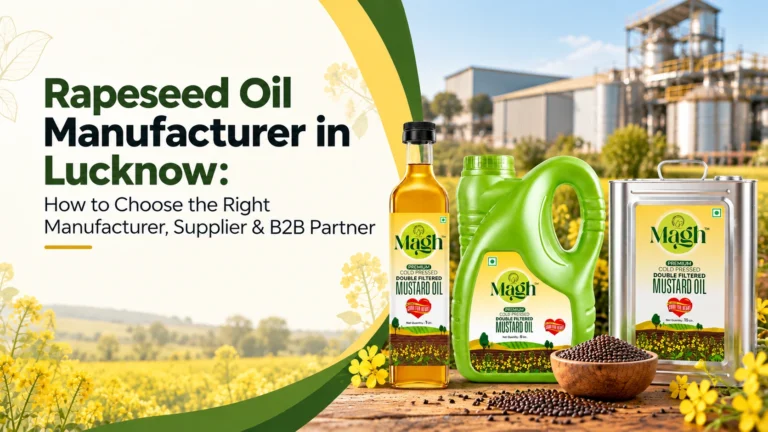
For example, Goyal Agro’s Magh range is positioned as Premium Yellow Mustard Oil / Rapeseed Oil, with cold-pressed and double-filtered product positioning. The company lists 1L, 5L and 15L formats for the range.
This is a good example of why product naming needs context.
The product is marketed using both:
Yellow Mustard Oil
and
Rapeseed Oil
rather than treating these terms as completely disconnected categories.
Where Does Kachi Ghani Mustard Oil Fit In?
Now comes another term that often creates confusion:
Kachi Ghani Mustard Oil
Kachi Ghani describes a particular traditional oil-processing positioning rather than simply being another name for rapeseed oil.
Under the FSSAI standard for rapeseed/mustard oil, oil can be labelled “Kachi Ghani” or “Cold Pressed” when it meets the specified natural allyl isothiocyanate requirement.
This is important because:
Rapeseed/Mustard Oil = oil category
while
Kachi Ghani / Cold Pressed = processing/labeling claim subject to applicable requirements
So these terms should not be treated as direct synonyms.
Rapeseed Oil vs Kachi Ghani Mustard Oil
These two are often compared, but they answer different questions.
If you ask:
“What type of oil is it?”
you are talking about the oilseed/product category.
If you ask:
“How was it processed?”
you are talking about processing terminology such as cold pressed or Kachi Ghani.
For example, Goyal Agro’s portfolio currently separates its products into two ranges:
Magh: Premium Yellow Mustard Oil / Rapeseed Oil
Neelima: Kachi Ghani Mustard Oil
The website describes Magh as cold pressed and double filtered, while Neelima is positioned as its Kachi Ghani mustard oil range.
How Does Processing Change the Product?
The seed is only one part of the story.
The processing method can influence the final oil’s:
- Aroma
- Flavour
- Appearance
- Natural components retained
- Filtration characteristics
- Shelf-life considerations
- Consumer experience
For example, cold-pressed oil is produced using mechanical extraction without the same type of high-temperature refining process associated with refined oils.
However, “cold pressed” should not automatically be interpreted as a blanket health claim.
The correct approach is to evaluate the actual manufacturing process, quality parameters and applicable standards.
FSSAI’s standards also specify conditions around extraction methods and refined oil requirements, including provisions concerning solvent extraction and refining.
Which One Is Better: Rapeseed Oil or Mustard Oil?
This question sounds simple, but there isn’t one universal answer.
It depends on what you are looking for.
If your priority is:
Traditional Indian flavour
→ You may prefer a mustard-oil product that matches your taste preference.
Yellow mustard oil
→ Look for a product specifically identified as yellow mustard oil and check its product specification.
Kachi Ghani positioning
→ Check that the product meets the applicable requirements for the Kachi Ghani/cold-pressed claim.
B2B supply
→ Look beyond the front label and check specification, packaging, consistency, documentation and supply capability.
International sourcing
→ Product specifications, regulatory compliance, documentation and destination-market requirements become particularly important.
So rather than asking “Which oil wins?”, the more useful question is:
Which oil specification fits your requirement?
What Should You Check Before Buying Mustard or Rapeseed Oil?
Whether you are a household consumer, retailer or B2B buyer, a few things deserve attention.
1. Read the Product Name Carefully
Check whether the product is described as:
- Mustard Oil
- Yellow Mustard Oil
- Rapeseed Oil
- Kachi Ghani Mustard Oil
- Cold Pressed Oil
- Refined Oil
Do not assume these terms are interchangeable.
2. Check the Label and Regulatory Information
FSSAI’s food standards cover product standards, labelling and safety requirements for edible oils.
3. Understand the Processing Method
If a product claims to be cold pressed or Kachi Ghani, look at the applicable product requirements and manufacturer information.
4. Look at the Manufacturer
For regular household purchases, brand trust matters.
For B2B purchases, the manufacturer becomes even more important because supply consistency, documentation and quality systems can directly affect your business.
5. For Bulk Buyers, Ask for Specifications
A serious B2B buyer should ask about:
- Product specification
- Pack size
- Minimum order quantity
- Batch information
- Quality documentation
- Packaging
- Delivery location
- Export documentation, where applicable
Why the Manufacturer Matters for B2B Buyers
Imagine you are a distributor.
You do not simply need one bottle of mustard oil.
You need the same product quality repeatedly, appropriate packaging, reliable supply and a manufacturer who can understand your commercial requirements.
This is where the difference between a simple retail brand and a manufacturing company becomes important.
Goyal Agro positions itself around yellow mustard oil, rapeseed oil and Kachi Ghani mustard oil manufacturing, along with B2B bulk supply for wholesalers, distributors, retailers, institutional buyers and export customers. Its website also documents HACCP, ISO 9001:2015, FSSAI licensing and export-related credentials including IEC and FIEO.
Its manufacturing facility is documented at Barabanki, Uttar Pradesh, with a corporate office in Lucknow.
For buyers searching for an Indian supplier, this distinction matters because the question is no longer just:
“Which oil should I buy?”
It becomes:
“Which manufacturer can supply the product I need consistently?”
Rapeseed Oil and Mustard Oil in the Indian Market
India has a long agricultural connection with rapeseed-mustard crops.
ICAR identifies rapeseed-mustard as an important oilseed group and lists crops including Indian mustard, toria, yellow sarson and gobhi sarson.
This agricultural diversity helps explain why the Indian market has so many names for closely related oils.
You may hear:
Sarson ka tel
Toria oil
Yellow mustard oil
Rapeseed oil
Kachi Ghani mustard oil
Mustard oil
The names may sound interchangeable in everyday conversation, but the seed variety, product specification and processing method are what provide the technical distinction.
Frequently Asked Questions
Is rapeseed oil the same as mustard oil?
Not necessarily. Rapeseed and mustard are closely related Brassica oilseed crops, and FSSAI’s Indian standard explicitly covers “Rapeseed oil (toria oil) or mustard oil (sarson ka tel)” as a defined category. The exact product depends on the seed and specification.
Is yellow mustard oil a type of rapeseed oil?
The terminology can overlap because yellow sarson and other rapeseed-mustard crops belong to the same broader group. However, the exact identity of a commercial product should be established from its label and specification rather than assuming that every yellow mustard oil is identical to every rapeseed oil.
What is the difference between Kachi Ghani and rapeseed oil?
Rapeseed oil describes an oil/product category, while Kachi Ghani describes a processing/labeling claim subject to applicable requirements. FSSAI specifies conditions for using the Kachi Ghani or Cold Pressed label.
Is rapeseed oil suitable for cooking?
Edible rapeseed/mustard oils are standardised under India’s food regulations. Whether a particular product is suitable for a specific culinary use should be determined from its product label, specification and applicable food standards.
What should I check when buying bulk rapeseed oil?
For B2B purchasing, check the exact product specification, seed/oil type, processing method, packaging, batch and quality documentation, minimum order requirements, delivery terms and the manufacturer’s ability to maintain consistent supply.